LP Siding or Hardie? How to Think About Siding on a Yakima Valley Home
The product you pick matters, but what goes on the wall underneath it matters more.
October 7, 2026 · 4 min read
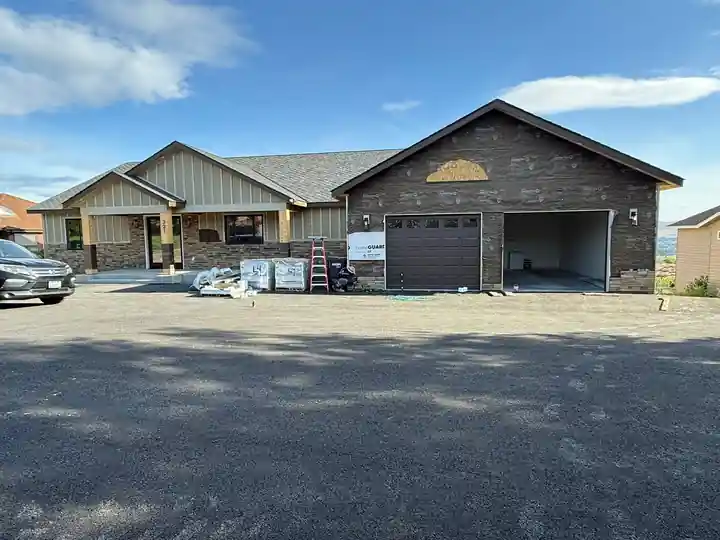
When people start planning siding, the question they bring is almost always LP or Hardie. It's a fair question, and there's no single right answer. But in our experience the decision that protects your house most isn't the brand on the boards. It's what's behind them. So let's cover both: the products, then the layers underneath, then how to put profiles and stone together so the house looks like one idea.
Two different materials
LP siding is an engineered wood product. Hardie is a fiber cement product, made from cement, sand and cellulose. They're both made to look like traditional siding, and both are widely used. LF Construction & Excavating installs any kind of siding, from LP to Hardie, so this isn't a sales pitch for one of them. It's how the trade-offs tend to look on a job.
- Weight and handling: fiber cement is heavy and takes more hands to carry and hold in place. Engineered wood is lighter and easier to work with on ladders and scaffolds.
- Cutting: engineered wood cuts like wood. Fiber cement makes fine dust when cut, so it needs dust control and the right protection for whoever is cutting.
- Cut edges: both products have installation instructions about sealing and finishing cut ends and keeping clearances. Follow them. Skipped steps are where problems start.
- Movement: all siding expands and contracts with moisture and temperature. The Yakima Valley swings from hot dry summers to cold winters, so gaps and fastening matter.
- Paint and finish: both take paint, and both need the finish kept up. Ask what the manufacturer expects for repainting, and ask for the actual documents.
We aren't going to quote warranty terms or prices in a blog post. They change, and the manufacturer's current documents are the real source. Ask your builder to show them to you for whichever product you choose.
What goes on the wall first
Siding sheds most of the water, but not all of it. Wind-driven rain gets behind boards, so the real weather barrier is the layer underneath. That starts with housewrap over the sheathing, lapped so each upper layer sits over the one below it, like shingles. Water that gets in should run down and out, never in.
Flashing is the second half. Windows and doors need flashing at the sill, the sides and the head. Where a roof meets a wall, flashing has to carry water out over the siding rather than behind it. Where siding meets stone, there needs to be a flashing detail too. These are small pieces of metal and tape that nobody sees after the job is done, and they're the difference between a wall that stays dry and one that rots from the inside. When you walk a house in housewrap, take a look at the tape at the window corners. That's where a careful crew shows itself.
Lap, board and batten, or both
Lap siding runs in horizontal courses and reads as traditional, calm and wide. Board and batten runs vertical, with narrow strips covering the seams between wider boards. It draws the eye up, which suits gables and tall walls, and it suits ramblers that need some height.
You don't have to pick one. Plenty of houses use board and batten on the main face and lap on a back wing or a garage, or switch profiles on a gable to break up a big wall. The rule that keeps it looking intentional is to change profiles where the building itself changes, at a corner, a gable line or a change in plane, never in the middle of a flat wall.
Pairing siding with stacked stone
Stone at the base of a wall is a common look in the valley, and it works because it grounds the house. One finished rambler in LF's photo library pairs board and batten with a stacked-stone base, and a stone-fronted garage wing shows siding crews working above it. The pairing works when a few things are handled:
- Set the stone height deliberately. Too low looks like a skirt, too high swallows the siding.
- Cap the top of the stone and flash the transition so water can't run behind the siding.
- Pick siding color from samples held against the actual stone, in daylight, on site. Strong valley sun changes how both read.
- Keep the profile simple. Stone brings texture, so a quiet siding profile usually looks better next to it.
Whichever product you choose, siding is only as good as the install behind it. If you're weighing options for your build, read the Siding page under Services and call (509) 859-5594 to talk it over.
LF Construction & Excavating, (509) 859-5594
Call (509) 859-5594More articles
From Buying the Lot to Pouring Footings: What Happens in Between
On a hillside lot above the valley, the dirt work decides how the rest of the build goes, so here is the order it runs in.
Why One Crew From Dirt to Roof Keeps a Custom Home on Schedule
Most schedule slips happen in the gaps between trades, and a custom home has several of them.